
|
|
War sparked by what on first glance appears to be a trivial disagreement over the Christian shrines of Jerusalem, but that was actually the result of long term European tensions. Russia had long been expanding south at the expense of various Muslim states, and the Ottoman Turks, slowly gaining ground, while the ever weaking Ottoman empire still controlled large areas of the Balkans. The Russians were the guardians of the Christian shrines within the Ottoman Empire, and when a dispute broke out between Orthodox and Catholic Christians in Jerusalem, France decided to intervene as protector of the Catholics, gaining special status from the Turks in 1852. Tsar Nicholas I of Russia decided to use the tension in an attempt to gain control of Constantinople and with it direct access to the Mediterranean. This alarmed France, long term allies of Turkey, and enemies of Russia, and Britain, who objected to any change in the balance of power, and also had rivalries with Russia further east. Russia issued demands in May 1853, which were soon refused, and Russian troops began to occupy Turkish Moldavia and parts of Rumania in July. The Turks declared war on Russia in October, and a Turkish army crossed the Danube, defeating the Russians at the battle of Oltenitza (4 November 1853), in southern Rumania. On 30 November the Russians defeated a Turkish fleet at Sinope, in an encounter most significant for the introduction of shell guns by the Russians, although their control of the Black Sea was short lived, and a Franco-British fleet entered the Black Sea in January 1854. On 28 March 1854, Britain and France declared war on Russia, and moved to help the Turks.
Despite the name of the war, fighting was not limited to the Crimea. Oltenitza did not end fighting in the Balkans, and on 20 March 1854 the Russians crossed the Danube, invading Turkish Bulgaria. However, Austria moved quickly to oppose the Russian expansion, gaining Turkish permission to enter their Balkan provinces, and by the start of August the Russians withdrew back across their own border. Fighting also happened in the Caucasus, where the Russians besieged the fortress of Kars, which despite a brave defence was forced to surrender on 26 November 1855, only months before peace negotiations ended the war. However, the most important fighting was on the Crimean peninsular. Austria's intervention had in effect achieved the British and French aims, removing the Russian presence in the Balkans, but it was decided to reduce Russian naval power in the Black sea by the occupation and destruction of the main Russian naval base at Sevastopol.
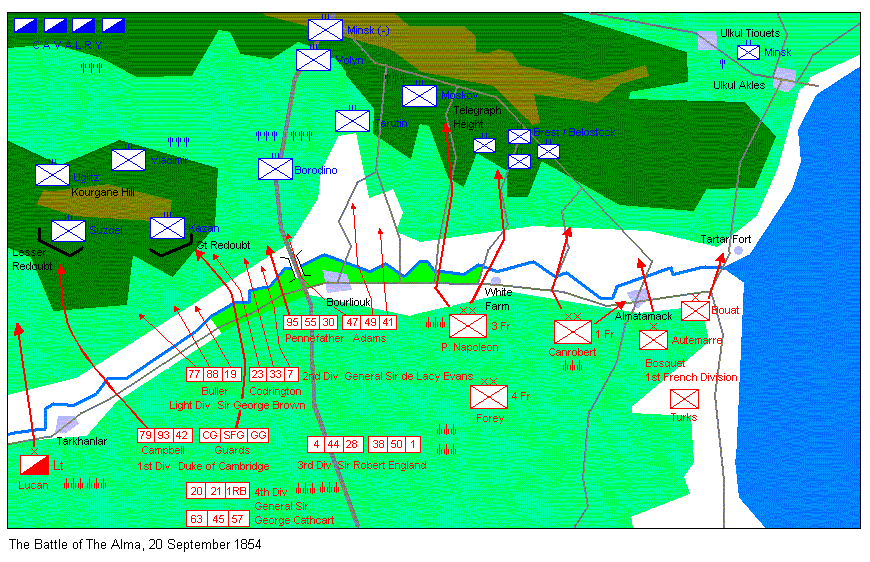
The campaign in the Crimea is most notable for the poor quality of the leadership of both sides. This was amply demonstrated at the start of the campaign. The allied expedition sailed before the leaders - Lord Raglan for the British, the seriously ill Marshal Armand de Saint-Arnaud for the French - had even decided where to land, only picked their point once they had reached the Crimea, choosing to land at Old Fort, an open beach 30 miles north of Sevastopol. The landing took five days (13-18 September 1854), and this time the Russian commander, Prince Alexander Menshikov, showed his lack of ability, failing to take the opportunity to attack the vulnerable allies. The allies now started to move towards the port, and only now, with the allies outnumbering him, did Prince Menshikov attempt to stop them (battle of the Alma, 20 September 1854). An attempt to hold the line of the River Alma cost Menshikov 5,700 of his 36,400 men, and the allies 3,000 of their 52,000, although Russian reinforcements were already starting to reach the area. Menshikov pulled back to Sevastopol, which the allies approached on 25 September. Now the idiocy of their landing point became apparent, as with no easy port in their hands, the allies were forced to march around Sevastopol to Balaklava and Kamiesch, south of the city before they could begin a siege. At the same time Menshikov was moving the bulk of his army away from the city to join with Russian reinforcements, and it was only by chance that the two armies failed to collide.
The allies regained contact with their fleets, and established themselves in their new bases, the British at Balaklava, the French at Kemiesch, where the death of Marshal St. Arnaud raised General Francois Canrobert to command. The allies were now free to concentrate on the siege of Sevastopol (17 October 1854-8 September 1855), but to the amazement of the Russian garrison of Sevastopol, missed their chance to simply walk into the city before it's defences had been completed. Instead, while the bulk of the allies army protected their flank against the Russian field army, the siege was slowly put into place (8-16 October), before the bombardment began (17 October). However, over the previous weeks, Colonel Frants Todleben, the Russian chief engineer, had built up new fortifications which almost totally negated the allied bombardment. The Russians made repeated efforts to disrupt the siege, attacking the vulnerable supply lines between the besieging troops and their ports.
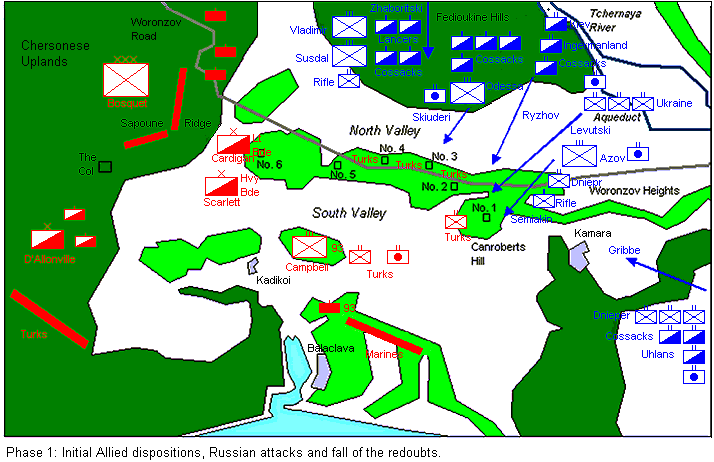
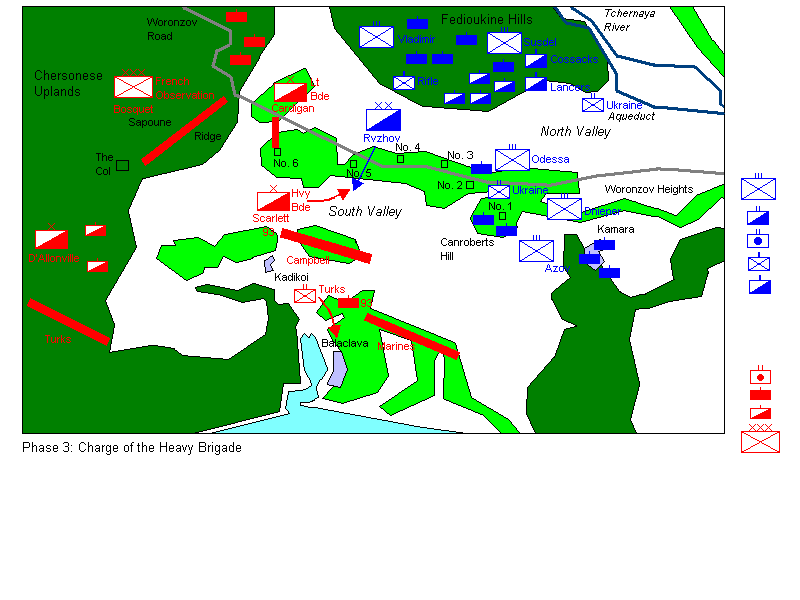
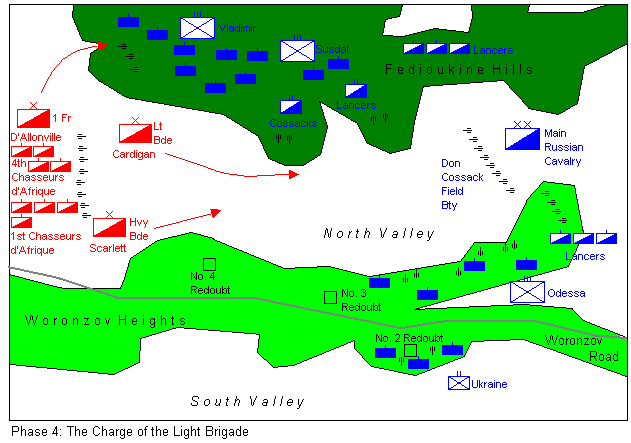
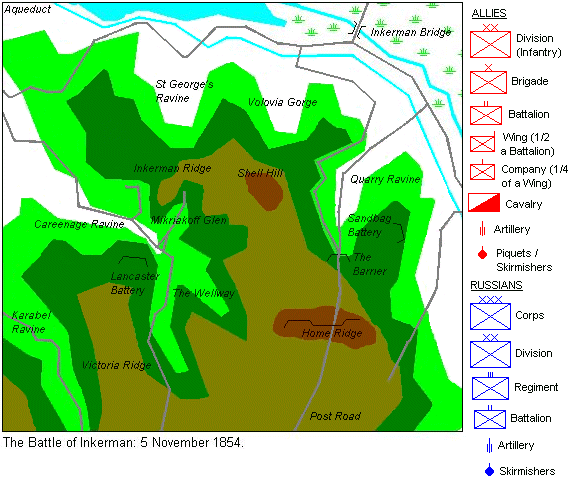
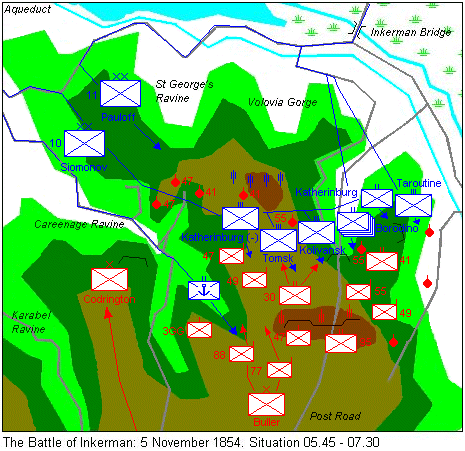
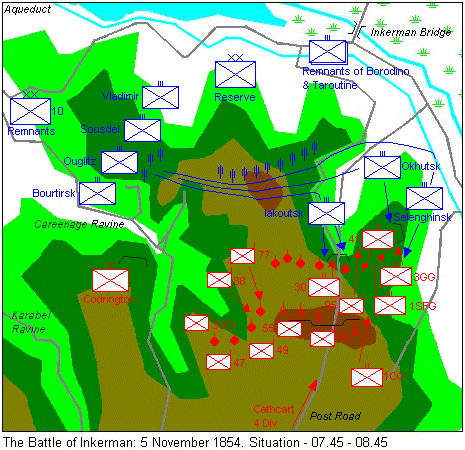
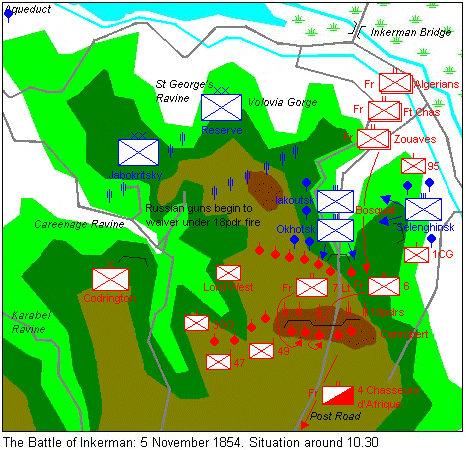
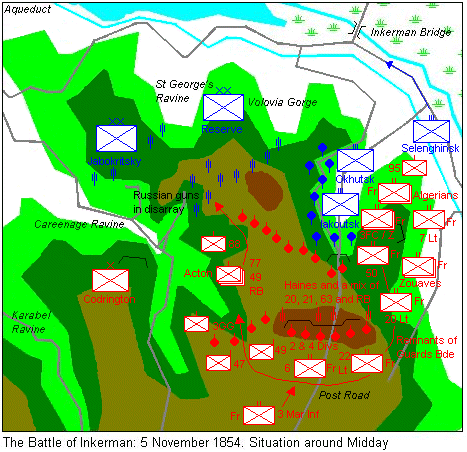
The first attempt, the battle of Balaklava (25 October 1854), is most famous for the Charge of the Light Brigade, in which 247 of the 673 Light Cavalry Brigade were killed attacking a battery of Russian guns by charging them along a valley lined by yet more Russian guns. However, the main result of the battle was to leave Menshikov's army dominating the only proper road between Balaklava and Sevastopol. A second Russian attempt led to the battle of Inkerman (5 November 1854), which degenerated into a formless melee after both the British and Russians lost effective control of their armies. The battle was won by the late arrival of a French division, which drove off the Russians, who suffered by far the heavier casualties. The fighting then ended for the winter, but the misery of the allied troops only got worse. Neither the French or British were fully prepared for a winter siege, while the Russians still commanded the road between Balaklava and Sevastopol. A storm sank thirty transport ships containing most of the British supplies, and Cholera raged through the camp, reducing the British army to only 12,000 effective soldiers.
For the first time, improved technology allowed news to reach home very quickly, and the telegraph reports sent by William Russell, war correspondent of the Times of London enraged British public opinion to the extend that the government of Lord Aberdeen fell, the first time the condition of the fighting men had aroused such emotions. Conditions slowly improved early in 1855. Florence Nightingale's famous nursing innovations improved the military hospitals, while a newly constructed road and railway improved the supply route between Balaklava and Sevastopol. Another Russian attempt to intervene, under Prince Michael Gorchakov (battle of Eupatoria, 17 February 1855), was repulsed by the Turks. An Easter bombardment (8-18 April 1855) destroyed a great deal of the Russian defences, while the resignation of Conrobert led to the appointment of General Pelissier, a more able commander. Finally, the capture of Kerch on 24 May, which secured allied command of the Sea of Azov, severed the Russian overland supply lines. Over the remains of the summer, the allies slowly nibbled at the Russian defences, while the battle of the Traktir (16 August 1855), saw the final Russian attempt to relieve the city defeated by French and Sardinian troops. Finally, on 8 September 1855, the French launched one of the few well planned attacks of the war, aimed at the Malakoff, one of the two key strongpoints of the defence. A heavy bombardment was followed by a well timed assault by an entire French corp. Surprise was achieved by the first use of synchronised watches to time an assault, and after intensive fighting the Malakoff was captured. This put the remaining strongpoint under an intolerable strain, and so that night Prince Gorchakov evacuated the city.
The capture of Sevastopol was the last significant fighting of the war. Peace terms were agreed on 1 February 1856 at Vienna, and the final peace agreed at the Congress of Paris (28 February-30 March 1856), resulting in the Treaty of Paris. Russian lost her dominance in the Balkans, and agreed to respect the integrity of the Ottoman Empire. In some ways Austria was the biggest loser. Having chosen to defy the Russians in the Balkans, she lost her main ally, and over the next few years found that Britain and France were not interesting in propping her up. Indeed, within three years the War of Austria with France and Piedmont (1859), lost her much of her Italian possessions, while the Austro-Prussian War of 1866 ended any Austrian influence in Germany. Tsar Alexander II, who came to the Russian throne in March 1855, realised that the war demonstrated the urgent need for modernisation in Russia
 The Crimean War, John Sweetman, Osprey, 2001, 96 pages. A good introduction to the events of the Crimean War, if perhaps a little too focused on the British view of the war. [see more]






 The First VCs - The Stories behind the First Victoria Crosses of the Crimean War and the Definition of Courage, John Grehan.
Combines a history of the earliest winners of the Victoria Cross with a history of the foundation of the medal itself, all taking place against the background of the Crimean War. Looks at the sort of deeds that were felt to be worthy of reward when the first Victoria Crosses were awarded after the end of the war, as well as the debate that led to the creation of the award in the first place [read full review]
The First VCs - The Stories behind the First Victoria Crosses of the Crimean War and the Definition of Courage, John Grehan.
Combines a history of the earliest winners of the Victoria Cross with a history of the foundation of the medal itself, all taking place against the background of the Crimean War. Looks at the sort of deeds that were felt to be worthy of reward when the first Victoria Crosses were awarded after the end of the war, as well as the debate that led to the creation of the award in the first place [read full review]


